Churches and eastward orientation have been intertwined since early Christianity, but the assumption that all churches face east is a myth worth dismantling. The practice is rooted in profound theological symbolism, yet geography, urban planning, local tradition, and practical constraints have produced an extraordinarily diverse architectural landscape. Understanding why some churches face east — and why many don't — reveals as much about faith as it does about the communities that built them.
The idea that a church must face east feels almost self-evident to anyone raised in certain Christian traditions. The rising sun, the resurrection, the return of Christ — the symbolism is layered and ancient. But walk through any major city, from São Paulo to Nairobi to Seoul, and you'll quickly notice that religious architecture rarely bends to a single rule. The orientation of a church tells a story, but it's never the same story twice.
Orientation in religious architecture carries deep spiritual weight
The eastward orientation of Christian churches, known as ad orientem (Latin for "toward the east"), is one of the oldest and most theologically charged conventions in religious architecture. Its origins predate the construction of grand cathedrals and can be traced to the earliest Christian communities of the 2nd and 3rd centuries.
The theological roots of eastward orientation
The east holds a specific place in Christian cosmology. The Gospel of Matthew (24:27) describes the return of Christ coming "like lightning from the east." Early Christian writers, including Origen and Tertullian, associated prayer toward the east with the anticipation of the Second Coming. The rising sun became a natural metaphor for the resurrection — light conquering darkness, life overcoming death.
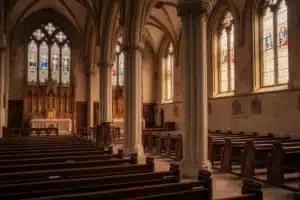
This theological framework shaped the physical design of churches for centuries. In a traditional layout, the altar is placed at the eastern end (the apse), with the congregation facing east during liturgy. The priest, standing before the altar, leads the faithful in a shared orientation toward the divine. This isn't merely aesthetic. It's a spatial theology — the architecture itself participates in the act of worship.
How the compass became a liturgical instrument
Byzantine and Romanesque church builders treated orientation as a liturgical requirement, not an architectural preference. Medieval canon law in various traditions explicitly encouraged eastward placement of the altar. The Didascalia Apostolorum, an early Christian document, instructed that churches should be oriented "toward the east," reinforcing the idea that sacred space had a directional dimension.
The result, across medieval Europe, was a remarkably consistent pattern: the nave stretches west to east, the main entrance faces west (symbolizing the world, darkness, and the penitent's journey), and the altar faces east (symbolizing heaven, light, and salvation). Pilgrims entering through the western portal were literally walking toward the light.
The term “orientation” itself derives from the Latin oriens, meaning “east” or “rising sun.” Every time someone speaks of orienting a building, they are invoking this ancient practice of aligning sacred space with the direction of sunrise.
Cultural and geographic variations reshape the tradition
The eastward rule was never as universal as its proponents claimed. Across different continents, denominations, and centuries, local conditions — geographic, political, and cultural — bent the convention in ways that reveal just how flexible religious architecture has always been.
The urban grid problem
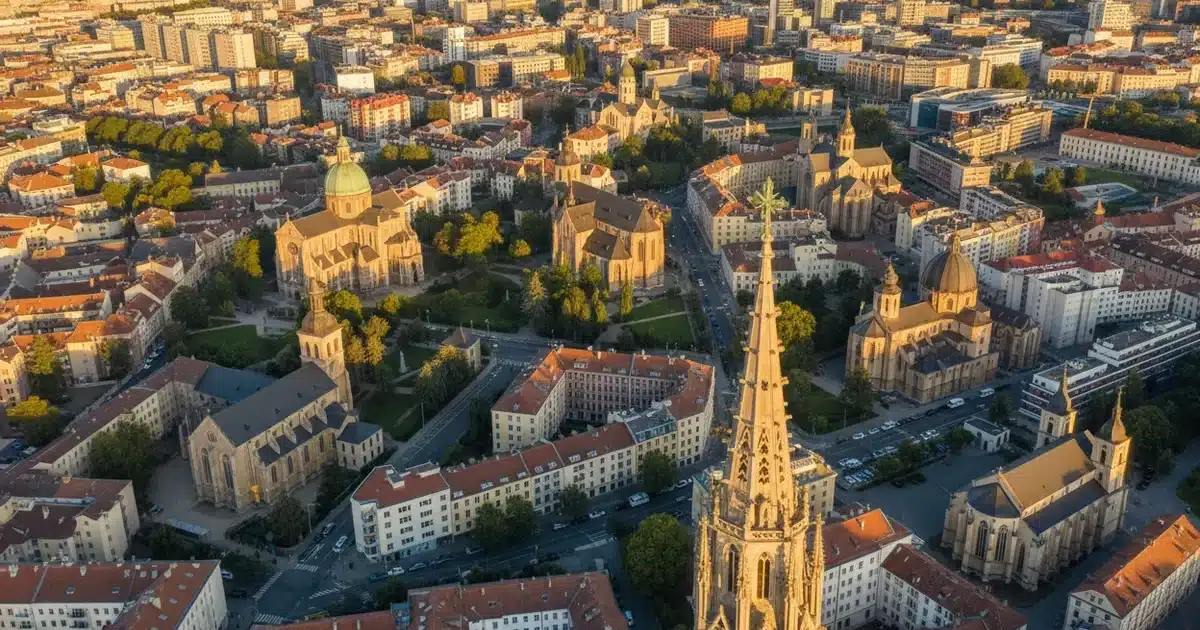
Cities don't cooperate with cardinal directions. Rome, Paris, London — the street grids of historic urban centers follow topography, property boundaries, and medieval land use patterns, not the compass. When a church was inserted into an existing urban fabric, its orientation was frequently dictated by the available plot of land.
Notre-Dame de Paris is a famous example: the cathedral faces roughly east, but the alignment is imprecise, influenced by the shape of the Île de la Cité. Many parish churches in London, rebuilt after the Great Fire of 1666 by Christopher Wren, face in directions that reflect street patterns rather than theological preference. Wren himself acknowledged the constraint, noting that the sites available to him rarely permitted strict eastward orientation.
Regional traditions outside Europe
Christian communities outside the European heartland developed their own spatial theologies, sometimes diverging significantly from the ad orientem model. Ethiopian Orthodox churches, among the oldest Christian institutions in the world, follow their own liturgical rules shaped by a blend of Judaic, Coptic, and indigenous Ethiopian traditions. The orientation of an Ethiopian church often reflects local topography and the specific requirements of the tabot (a replica of the Ark of the Covenant), rather than strict compass alignment.
In East Asia, where Christianity arrived relatively recently and in competition with established spatial traditions, church builders frequently adapted to local urban layouts. Churches in Tokyo, Hong Kong, and Shanghai often face whatever direction the street allows. The spiritual meaning of the space is constructed through interior design, liturgy, and community practice rather than cardinal orientation.
Indigenous Christian communities in Latin America and sub-Saharan Africa similarly developed hybrid architectural practices, blending Catholic or Protestant building conventions with local cosmologies that assign different significance to cardinal directions. In some Andean communities, for instance, spatial orientation in sacred buildings relates to mountain peaks and ancestral landmarks rather than the rising sun.
Many notable churches do not face east — and for good reason
The list of prominent churches that deviate from eastward orientation is long enough to put the "universal rule" argument to rest. These deviations are not errors or oversights. They are deliberate responses to specific conditions.
Practical constraints that override tradition
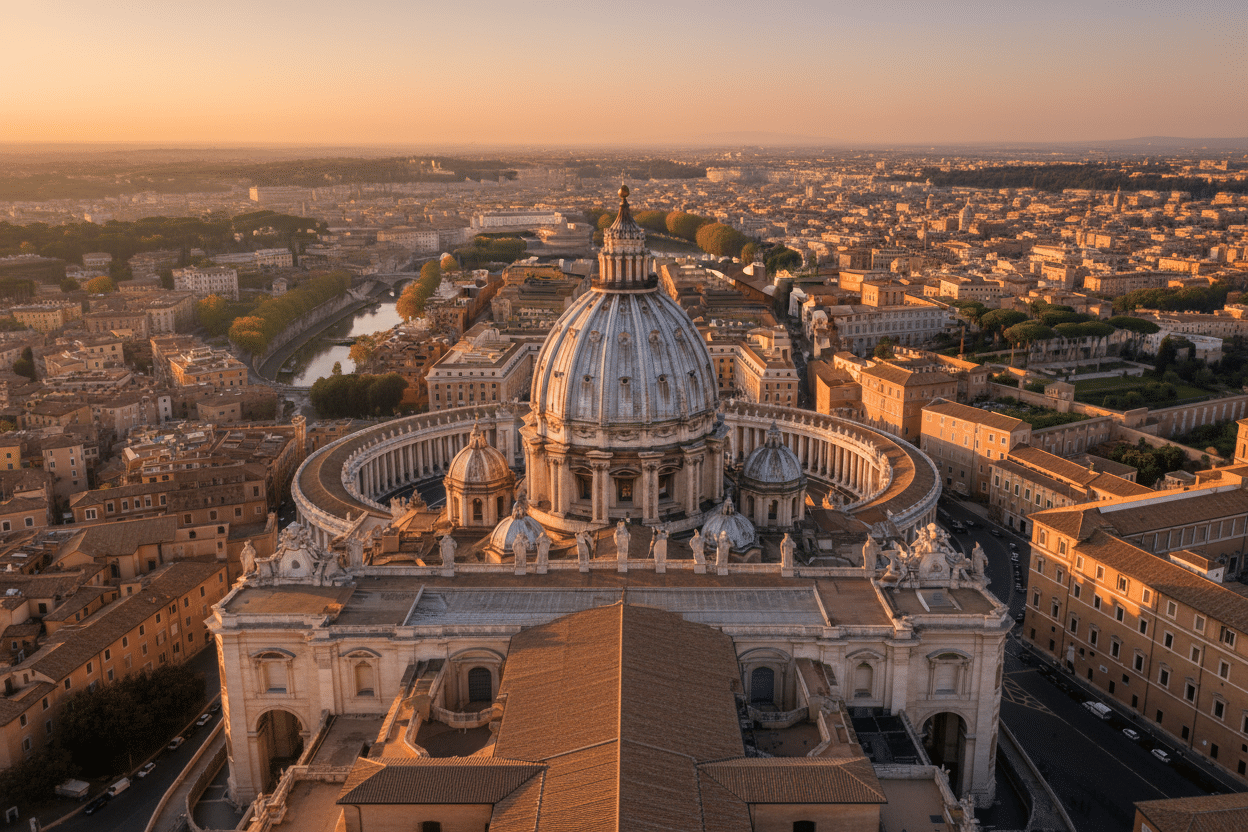
Saint Peter's Basilica in Vatican City is perhaps the most striking counterexample. The basilica faces west, with the altar at the western end. This arrangement dates to the original Constantinian basilica built in the 4th century, which followed the model of Roman civic basilicas rather than strict liturgical orientation. The pope, celebrating Mass at the high altar, faces east — toward the congregation and toward the entrance — which means the building itself faces west. This inversion influenced countless churches that sought to emulate Rome's prestige.
Hagia Sophia in Istanbul, constructed under Emperor Justinian I in 537 AD, faces roughly east but with a notable deviation. The constraints of the site, situated on a promontory above the Bosphorus, meant that a precise eastward alignment was impossible. The architects accepted a compromise, and the building's spiritual authority was never diminished by it.
Protestant and modern church design
The Protestant Reformation of the 16th century introduced a fundamental shift in how sacred space was conceived. For Lutheran, Calvinist, and later Anglican reformers, the sermon — not the Eucharist — became the central act of worship. This reoriented the interior logic of churches: the pulpit moved to the center, the congregation gathered around it, and the directional symbolism of ad orientem lost much of its urgency.
Nonconformist chapels in Britain and New England were built with little regard for compass orientation. A Methodist chapel in Yorkshire or a Baptist meeting house in Massachusetts was designed for audibility and communal gathering, not solar alignment. The spiritual space was defined by the gathered community, not by the direction of the altar.
Contemporary church architecture has pushed this further. Modernist churches built in the 20th and 21st centuries — by architects like Le Corbusier (Notre-Dame du Haut in Ronchamp), Tadao Ando (Church of the Light in Osaka), or Renzo Piano — prioritize the manipulation of natural light, acoustic performance, and the relationship between interior and landscape over any concern with compass bearing. These buildings create profound spiritual experiences through entirely different means.
- Deep theological symbolism linking east to resurrection and the return of Christ
- Creates a unified liturgical direction for priest and congregation
- Connects the building to centuries of Christian architectural tradition
- Reinforces the idea that sacred space has a cosmic, not merely functional, dimension
- Urban site constraints frequently make strict orientation impossible
- Protestant traditions deprioritize directional liturgy in favor of communal gathering
- Non-European Christian communities have distinct spatial cosmologies
- Modern architecture achieves spiritual effect through light and form, not compass bearing
Contemporary religious practice is redefining what orientation means
The question of whether churches face east has taken on new dimensions in the 21st century, as Christian communities worldwide navigate the tension between tradition and adaptation. For some, the revival of ad orientem worship is a deliberate act of theological recovery. For others, the direction a church faces is simply irrelevant to the vitality of faith.
The liturgical renewal movement
Within Roman Catholicism, a significant movement has emerged around the recovery of traditional liturgical practices, including ad orientem celebration of the Mass. Advocates argue that when both priest and congregation face east together, it restores a sense of shared orientation toward the transcendent — the liturgy becomes a collective journey rather than a performance directed at an audience. Pope Benedict XVI was among the most prominent voices for this position, and his influence can be seen in the growing number of parishes that have returned to eastward celebration, regardless of which direction the building itself faces.
The distinction matters: a church can face any direction on the compass, but the priest can still celebrate ad orientem by turning toward the liturgical east, which is defined by the position of the altar rather than an actual compass bearing. In churches where the altar is at the western end (as in Saint Peter's), the liturgical east is physically west. The symbolism survives the geographic inversion.
New church construction and community identity
New church buildings commissioned by growing Christian communities in Africa, Asia, and Latin America reflect a different set of priorities. In Nigeria, South Korea, and Brazil — where some of the fastest-growing Christian congregations in the world are found — church buildings are designed primarily for capacity, acoustic quality, and visual spectacle. Orientation toward a cardinal direction rarely appears in architectural briefs.
This isn't secularization. These communities are intensely religious. But their spatial theology is expressed through scale, light, sound, and the energy of collective worship rather than through compass alignment. The meaning of sacred space is being continuously renegotiated, and the eastward orientation that defined European Christianity for a millennium is just one option among many. The tradition remains alive for those who carry it, but it has never been — and was never going to be — the universal rule it was sometimes claimed to be.