
The Lutheran Church is one of the world's largest Protestant denominations, tracing its roots to Martin Luther's 16th-century Reformation. Built on the principles of grace, faith, and Scripture alone, it has grown into a global community of roughly 80 million members whose influence on education, social welfare, and democratic values extends far beyond Sunday worship.
The Lutheran Church rarely makes headlines, yet its fingerprints are everywhere — on Western legal thought, on public education systems, on the architecture of modern social welfare. Understanding what the Lutheran Church is means understanding one of the most consequential religious and cultural movements in human history, and why it still matters in the present day.
Origins of the Lutheran Church: Martin Luther and the Reformation
The Lutheran Church did not emerge from a clean institutional decision. It erupted from a crisis. On October 31, 1517, an Augustinian monk and theology professor named Martin Luther nailed his Ninety-Five Theses to the door of the Castle Church in Wittenberg, Germany. His target was the sale of indulgences — the Catholic practice of selling certificates that promised the reduction of punishment for sins. Luther's argument was theological at its core: salvation cannot be purchased, earned, or negotiated through human effort.
The response from Rome was swift and hostile. By 1521, Luther had been excommunicated by Pope Leo X and declared an outlaw by the Holy Roman Emperor at the Diet of Worms. But the movement he sparked was already unstoppable. Princes, theologians, and ordinary citizens across German-speaking territories rallied around his ideas, and what began as an internal church dispute became a full-scale religious revolution — the Protestant Reformation.
The three pillars that define Lutheran theology
Luther's theology rested on three foundational principles, often expressed in Latin: Sola Scriptura (Scripture alone), Sola Fide (faith alone), and Sola Gratia (grace alone). These were direct challenges to medieval Catholic teaching, which held that salvation depended on a combination of faith, works, and the authority of the Church.
Sola Scriptura asserted that the Bible, not papal decree or church tradition, was the ultimate authority in matters of faith. Sola Fide held that justification before God comes through faith, not through moral effort or sacramental ritual. And Sola Gratia declared that this faith itself is a gift from God, not something a person generates through personal virtue. Together, these three principles dismantled centuries of ecclesiastical power and placed the individual believer at the center of the spiritual life.
The Augsburg Confession and the birth of a denomination
By 1530, Lutheran theology had been formally codified. The Augsburg Confession, drafted primarily by Philip Melanchthon and presented to Emperor Charles V, became the defining doctrinal document of Lutheranism. It remains the foundational confession of faith for Lutheran churches worldwide. The Book of Concord, compiled in 1580, expanded this into a comprehensive collection of Lutheran doctrinal standards that still govern confessional Lutheran bodies today.
Lutheran beliefs and practices: what actually happens inside the church
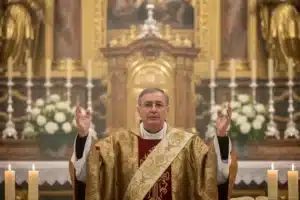
Lutheran worship is liturgical. Walk into a traditional Lutheran service and you will find a structured order — processional hymns, Scripture readings, a sermon, and the celebration of the Lord's Supper. This is not accidental. Luther did not reject the Catholic liturgical tradition wholesale; he reformed it, stripping away what he saw as human additions while preserving the rhythm of communal worship that had shaped Christian life for centuries.
The sacraments: baptism and the Eucharist
Lutherans recognize two sacraments: Baptism and the Eucharist (also called Holy Communion or the Lord's Supper). On both, Lutheran doctrine stakes out a distinctive position.
Infant baptism is practiced and defended as a means of grace — God acting on the child before the child can act on God. On the Eucharist, Luther broke sharply with the Swiss reformer Zwingli, who taught that the bread and wine were purely symbolic. Luther insisted on the Real Presence: Christ's body and blood are truly present "in, with, and under" the bread and wine, though without the Catholic doctrine of transubstantiation. This distinction may sound technical, but it has divided Protestant Christianity for five centuries.
Preaching, music, and the role of the congregation
Luther understood that if ordinary people were to engage with Scripture, they needed to encounter it in their own language. His translation of the Bible into German, completed in 1534, was as much a cultural act as a religious one. He also wrote hymns — including the famous A Mighty Fortress Is Our God — and established congregational singing as a central element of worship. The Lutheran tradition subsequently produced Johann Sebastian Bach, whose cantatas and Passions remain among the greatest achievements in Western music.
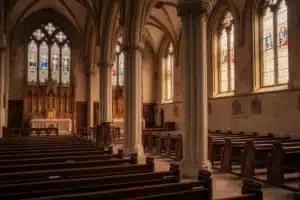
Lutheran church buildings vary enormously, from ornate medieval structures inherited from the Catholic Church to plain modern halls. Unlike some traditions, Lutheranism has no single architectural mandate — though the altar, pulpit, and font remain the three focal points of the sanctuary. If you’ve ever wondered whether all churches face east, Lutheran practice is equally varied on this point.
The Lutheran Church today: structure, scale, and global reach
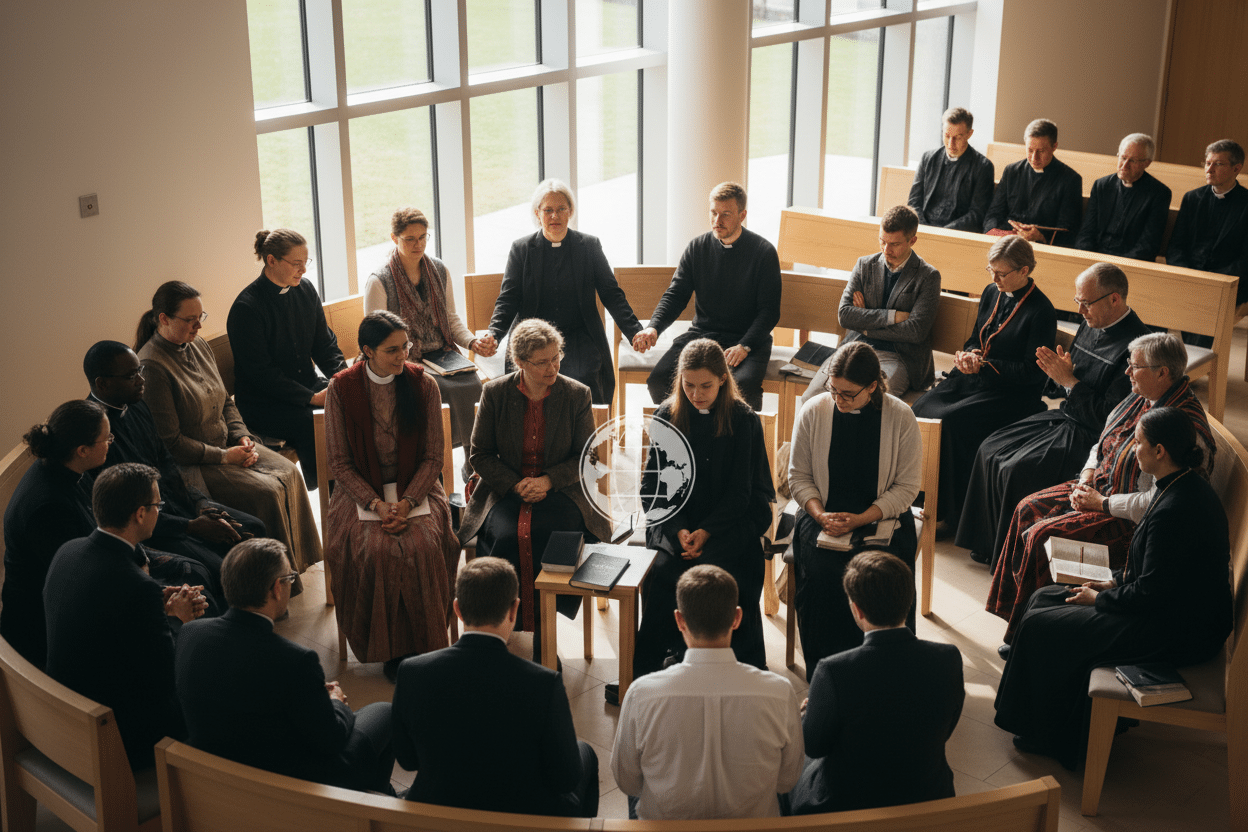
The Lutheran Church is not one institution. It is a family of denominations spread across more than 150 countries, loosely connected through the Lutheran World Federation (LWF), founded in 1947 and headquartered in Geneva. The LWF represents approximately 77 million of the world's Lutherans, making it one of the largest global Christian communions.
Lutheran denominations in the United States
In the United States, the landscape is divided. The Evangelical Lutheran Church in America (ELCA), with roughly 3.5 million members, represents the more theologically progressive wing. It ordains women, allows the ordination of openly LGBTQ+ clergy, and has been engaged in ecumenical dialogues with Catholic, Episcopal, and Reformed churches. By contrast, the Lutheran Church-Missouri Synod (LCMS) and the Wisconsin Evangelical Lutheran Synod (WELS) hold to more conservative confessional positions, maintaining traditional stances on ordination and interfaith worship.
The ELCA's relationship with the Episcopal Church — formalized through the Called to Common Mission agreement in 2001 — is a good example of how Lutheran identity can evolve through ecumenical engagement. For those curious about how Episcopal churches are structured, the overlap with ELCA polity is more substantial than most people realize.
Global Lutheranism: from Scandinavia to sub-Saharan Africa
Lutheranism's geographic center of gravity has shifted. Scandinavia, once the heartland of Lutheran state churches, has seen dramatic membership declines. Sweden, Denmark, Norway, and Finland all maintain historic Lutheran churches that are now post-establishment institutions navigating secular societies. Meanwhile, Lutheranism is growing in Ethiopia, Tanzania, Madagascar, and Indonesia. The Ethiopian Evangelical Church Mekane Yesus alone claims over 10 million members, making it one of the fastest-growing Lutheran bodies in the world.
Lutherans worldwide, across more than 150 countries
Lutheranism and society: social engagement as a theological commitment
The Lutheran tradition has never understood faith as a purely private matter. Luther's doctrine of the "two kingdoms" — the spiritual realm governed by the Gospel and the temporal realm governed by law and reason — provided a theological framework for engaging the world without collapsing church and state into each other. Lutherans are called to serve their neighbors in both realms.
Education and social welfare: a historical legacy
Lutheran institutions built some of the earliest public school systems in Europe. Luther himself argued that civic authorities had an obligation to educate all children, boys and girls alike. This conviction drove the establishment of schools, hospitals, and orphanages across Lutheran territories from the 16th century onward. Organizations like Lutheran World Relief and Lutheran Social Services continue this tradition today, operating food programs, refugee resettlement services, and community development projects across dozens of countries.
The comparison with other Christian traditions is instructive here. The founding of the Catholic Church in the first century established a model of institutional charity that Lutheranism both inherited and reformed, directing social action through local congregations and parachurch organizations rather than a centralized hierarchy.
Contemporary social positions: where Lutheran bodies diverge
On questions like climate change, immigration, poverty, and racial justice, the ELCA has taken explicit institutional positions, framing them as expressions of Christian responsibility. The LCMS, working from the same theological tradition, arrives at different conclusions about the proper role of the church in political discourse, preferring to focus on individual congregational action rather than denominational advocacy.
This internal diversity is not weakness. It reflects a genuine theological tension within Lutheranism between prophetic engagement and institutional restraint — a tension that has existed since Luther himself refused to endorse the Peasants' War of 1524-1525, despite his own radical challenge to ecclesiastical authority.
Challenges facing the Lutheran Church in the 21st century
Declining membership in the West is the most visible pressure. The ELCA has lost roughly 30% of its membership since 2000. Scandinavian Lutheran churches face similar trajectories. The causes are structural — demographic aging, urbanization, secularization — and no denomination has found a reliable counter-strategy.
Maintaining doctrinal identity in a fragmented landscape
The deeper challenge is theological coherence. As Lutheran bodies engage in ecumenical partnerships, social advocacy, and liturgical innovation, the question of what makes a church distinctively Lutheran becomes harder to answer. The confessional documents of the 16th century remain the formal standard, but their practical authority varies enormously between denominations and congregations.
The gap between confessional Lutheranism — which insists on doctrinal fidelity to the Augsburg Confession and the Book of Concord — and cultural Lutheranism — which identifies more with heritage and community than with specific theological commitments — is widening. How Lutheran bodies navigate this gap will determine the character of the tradition in the coming decades.
Growth in the Global South and the future of the tradition
But the picture is not uniformly bleak. The explosive growth of Lutheran communities in East Africa, Southeast Asia, and Latin America is reshaping what Lutheranism looks like globally. These younger churches bring different liturgical styles, different social priorities, and different readings of the confessional tradition. The Lutheran World Federation increasingly reflects this pluralism, and the theological conversations between Wittenberg-rooted European bodies and rapidly growing African and Asian churches are among the most interesting in global Christianity today.
The Lutheran Church that Martin Luther set in motion in 1517 was never a static institution. It was an argument — about grace, about authority, about what it means to stand before God with nothing but faith. That argument is still alive, still contested, and still consequential enough to shape how hundreds of millions of people understand themselves and their obligations to the world around them.