The Catholic Church traces its origins to the ministry of Jesus Christ in 1st-century Judea, but its institutional formation unfolded over centuries — through the apostles, early councils, and the consolidation of Roman authority. The question of when exactly the Church was "founded" depends entirely on whether you're asking theologically, historically, or institutionally. Each answer is legitimate, and each reveals a different layer of one of history's most consequential organizations.
The founding of the Catholic Church is not a single event with a precise date. It's a process — one that began in the dusty towns of Roman Palestine, accelerated through persecution and martyrdom, and crystallized into a recognizable institution by the 4th century AD. Understanding that process requires tracing the roots of Christianity itself, the role of key figures, and the pivotal moments that transformed a small Jewish reform movement into the largest religious institution on earth.
The roots of Christianity in Second Temple Judaism
The Catholic Church did not emerge from a vacuum. Its earliest foundations lie firmly within Second Temple Judaism, the religious tradition practiced in Judea under Roman occupation during the 1st century BC and 1st century AD. Jesus of Nazareth was Jewish, his disciples were Jewish, and the earliest followers of what would become Christianity understood their movement as a fulfillment of Jewish prophecy rather than a break from it.
A reform movement inside Judaism
The initial community around Jesus operated within the framework of Jewish synagogues and temple worship. Early followers observed Jewish law, celebrated Jewish festivals, and read Jewish scriptures. What distinguished them was their belief that Jesus was the Messiah — the anointed one foretold in the Hebrew Bible. This belief created friction with Jewish religious authorities, but for the first decades after Jesus's death, the movement remained largely internal to Judaism.
The rupture came gradually. As the faith spread beyond Judea into the broader Greco-Roman world, questions arose about whether non-Jewish converts needed to follow Mosaic law. The resolution — that they did not — was a defining moment. It transformed the movement from a Jewish sect into something genuinely universal, which is precisely what the word "catholic" (from the Greek katholikos) means: universal.
The synagogue and the early church
The structural model of the early Christian community borrowed heavily from the synagogue. Gatherings for prayer, scripture reading, communal meals, and appointed leaders all reflected Jewish practice. This continuity is often overlooked in accounts of Christian origins, but it explains much about the early Church's organizational logic and its emphasis on community, scripture, and ritual.
The role of Jesus Christ in founding the Church
From a Catholic theological standpoint, the Church was founded by Jesus Christ himself, specifically through his words to the apostle Peter in the Gospel of Matthew: "You are Peter, and on this rock I will build my Church" (Matthew 16:18). This passage, known as the Petrine Commission, forms the doctrinal basis for papal authority and apostolic succession — the idea that authority flows in an unbroken line from Peter to every subsequent Bishop of Rome.
The Last Supper and the Eucharist
Beyond the Petrine Commission, Catholics point to the Last Supper as a foundational moment. The institution of the Eucharist — the ritual sharing of bread and wine as the body and blood of Christ — established the central sacrament around which Catholic worship is organized. This event, dated to approximately 30 AD by most scholars, is understood as the moment Jesus explicitly constituted a community with a defined ritual identity.
The theological argument is coherent on its own terms: if the Church is defined by its sacramental life and its connection to Christ, then its founding date is the ministry of Jesus, culminating in the Passion, death, and Resurrection. Most Catholic theologians place the formal institution of the Church at Pentecost, roughly 50 days after Easter, when the Holy Spirit descended upon the apostles and they began their public mission.
Catholic doctrine holds that the Church was founded by Christ around 30 AD. Historians, working from institutional and documentary evidence, typically point to the late 1st or early 2nd century as the period when a recognizable Church structure emerged. Both perspectives address real questions — they simply ask different ones.
The apostles and the construction of the early Church
After Pentecost, the apostles dispersed across the Roman Empire and beyond, establishing communities in major cities: Jerusalem, Antioch, Alexandria, Corinth, Ephesus, and eventually Rome. This missionary expansion, documented in the Acts of the Apostles and the Pauline letters, represents the earliest phase of institutional Church-building.
Peter and Paul in Rome
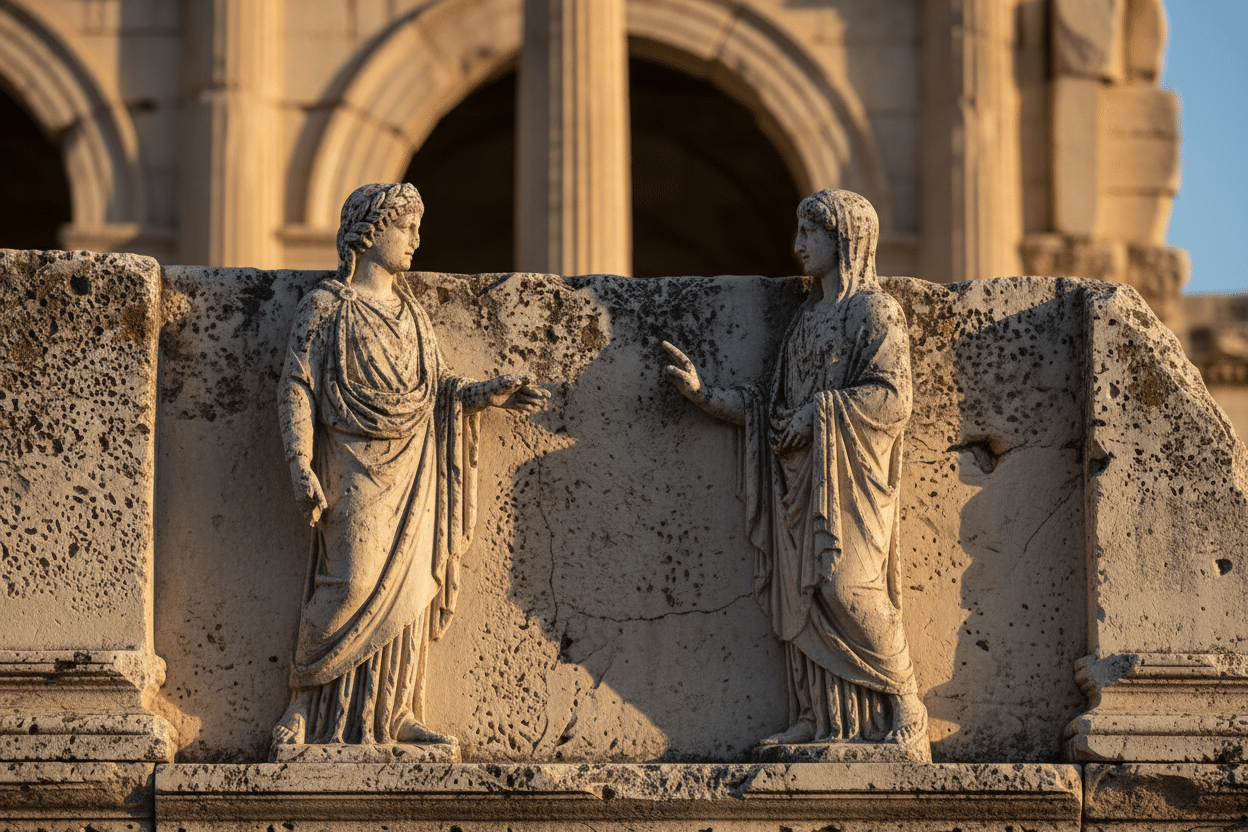
Peter and Paul are the two figures most directly associated with the Church of Rome. Tradition holds that Peter served as the first bishop of Rome and was martyred there under Emperor Nero around 64-68 AD. Paul, whose letters constitute the earliest written documents in the New Testament, was also executed in Rome during the same period. Their presence and martyrdom gave Rome a unique prestige among early Christian communities.
The significance of Rome was not purely symbolic. As the capital of the empire, Rome was the natural hub for communication, commerce, and authority. A community anchored there, led by figures of apostolic stature, carried weight that communities in smaller cities could not match. This is the historical basis for Rome's eventual claim to primacy — not simply a theological assertion, but a reflection of geopolitical reality.
The emergence of episcopal structure
By the late 1st and early 2nd century, a clear hierarchical structure was taking shape. Letters from figures like Ignatius of Antioch (writing around 107-110 AD) show a Church organized around bishops, priests, and deacons — the three-tiered structure still used today. Ignatius's letters are among the earliest evidence of the word "Catholic" applied to the Christian community, writing: "Wherever the bishop appears, there let the people be; as wherever Jesus Christ is, there is the Catholic Church."
This is a pivotal data point. By the early 2nd century, the term "Catholic Church" was in active use, and the institutional structure that defines it was recognizable. If a historical founding date is required, the period between 100 and 150 AD is the most defensible answer.
The Council of Nicaea and the consolidation of doctrine
The First Council of Nicaea in 325 AD marks the moment the Catholic Church became not just an institution but a state-backed one. Convened by Emperor Constantine I, who had legalized Christianity through the Edict of Milan in 313 AD, Nicaea brought together bishops from across the empire to resolve the Arian controversy — a dispute over the nature of Christ's relationship to God the Father.
The Nicene Creed and theological orthodoxy
The council produced the Nicene Creed, a statement of faith that defined orthodox Christian belief and explicitly rejected Arianism (the view that Christ was a created being, subordinate to God). The Creed remains central to Catholic worship to this day, recited at Mass every Sunday. Its formulation at Nicaea was not merely a theological exercise — it was an act of institutional consolidation, establishing which beliefs were authoritative and, by extension, which communities were legitimately "Catholic."
The Council of Nicaea in 325 AD did not found the Catholic Church, but it fundamentally shaped what the Church would become — doctrinally unified, imperially supported, and institutionally dominant across the Roman world.
Constantine and the Church-state alliance
Constantine's role deserves careful treatment. He did not convert the empire to Christianity overnight, and his own baptism came only on his deathbed in 337 AD. But his patronage transformed the Church's material and political circumstances beyond recognition. Churches were built with imperial funds. Bishops gained legal authority. The clergy received tax exemptions. Christianity went from a persecuted minority faith to the favored religion of the world's most powerful state within a single generation.
By 380 AD, Emperor Theodosius I issued the Edict of Thessalonica, making Nicene Christianity the official state religion of the Roman Empire. At this point, the Catholic Church as a public institution with defined doctrine, hierarchical authority, and imperial backing was fully formed. Whether this represents the "founding" or the "completion" of the Church is a matter of interpretation — but it's the moment the institution became recognizable in its modern form.
The Catholic Church across the centuries: continuity and transformation
The history of the Catholic Church from the 5th century onward is one of both remarkable continuity and profound transformation. The fall of the Western Roman Empire in 476 AD did not destroy the Church — it made it stronger in some respects. As secular Roman authority collapsed in the West, bishops and popes stepped into the administrative vacuum. Pope Leo I (reigned 440-461 AD) was already asserting papal supremacy over other bishops, a claim that would define Catholic ecclesiology for the next millennium.
The Great Schism of 1054
The most significant rupture in early Church history came in 1054 AD with the Great Schism, which split Christianity into the Roman Catholic Church in the West and the Eastern Orthodox Church in the East. The split was driven by theological disputes (notably over the filioque clause in the Creed), political tensions between Rome and Constantinople, and competing claims to ecclesiastical authority. From this point forward, "Catholic" and "Orthodox" became distinct identities, though both traditions claim continuity with the original apostolic Church.
- Theological continuity with Christ’s explicit commission to Peter
- Apostolic succession traceable to the 1st century
- Eucharistic practice established at the Last Supper
- Term “Catholic Church” in use by 107 AD (Ignatius of Antioch)
- No unified institutional structure before the 4th century
- Doctrinal orthodoxy only formally defined at Nicaea (325 AD)
- Imperial recognition transformed the Church’s nature fundamentally
- Papal authority as understood today developed over centuries
From medieval power to modern institution
The medieval Catholic Church exercised a degree of political and cultural authority that is difficult to overstate. It controlled vast territories, adjudicated legal disputes, ran Europe's universities, and shaped every dimension of daily life from birth to death. The Crusades, the Inquisition, the construction of Gothic cathedrals, the preservation of classical learning in monasteries — all of these are products of an institution that had grown from a small community of Jewish followers of an itinerant preacher into the organizing force of an entire civilization.
The Protestant Reformation of the 16th century (an angle deliberately set aside here) and the subsequent Council of Trent forced the Church to define itself more precisely in response to internal and external challenges. The First Vatican Council in 1869-1870 formally defined papal infallibility. The Second Vatican Council (1962-1965) opened the Church to significant internal reform and dialogue with the modern world. Through all of it, the institutional thread connecting the contemporary Catholic Church to the community gathered in Jerusalem at Pentecost remains the central claim of Catholic identity — contested by historians, defended by theologians, and fascinating to anyone who takes the long view of history seriously.